
AUTODROMO HERMANOS RODRIGUEZ - MEXICO CITY, MEXICO
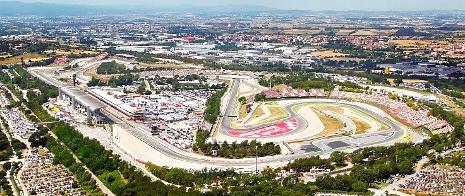
A motorsport race track in Mexico City, Mexico, named after the racing drivers Ricardo Rodríguez (1942–1962) and Pedro Rodríguez (1940–1971). The circuit got its name shortly after it opened when Ricardo Rodríguez died in practice for the non-Championship 1962 Mexican Grand Prix. Ricardo's brother Pedro was also killed behind the wheel nine years later. The circuit is located within the public park of the Magdalena Mixhuca Sports City in southeast Mexico City. The circuit is owned by the Government of the City, but is currently operated under concession by
Corporación Interamericana de Entretenimiento (CIE) through OCESA, one of CIE's subsidiaries. CIE also organizes the NASCAR and Desafío Corona races in this circuit and rents the circuits to other parties, including race organizers, automobile clubs and track amateurs for fees that are controversial due to their disproportionately high amounts compared to other ex-F1 courses. Built in the Magdalena Mixhuca public park in 1959, the circuit hosted its first Formula One Grand Prix in 1962, as a non-Championship race. The following year the Mexican Grand Prix became a full World Championship event. The circuit remained part of the F1 calendar through 1970, when spectator overcrowding caused unsafe conditions. When F1 returned in 1986, the circuit boasted a new pit complex, as well as improved safety all around, but left again
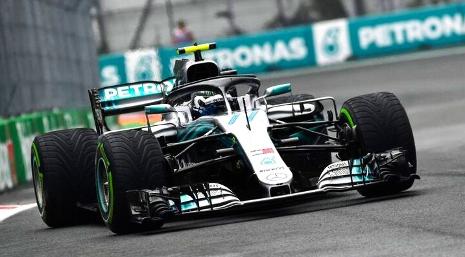
Formula 1
after 1992 due to safety concerns. In 2001 CIE and Forsythe Racing tasked D3 Motorsport Development with revamping the circuit. A redesign to include the Foro and a complete upgrade of the circuit was done. It saw a record crowd of 402,413 people attend a round of the CART Championship in 2002. It was announced in May 2012, that the circuit would again host the Mexican Grand Prix from 2013, in a five-year deal that would see it replace the European Grand Prix in Valencia, but this did not happen. The FIA listed the Mexican Grand Prix as the 19th round of the provisional schedule for the 2014 season, but it was not on the final schedule. The Mexican Grand Prix was listed on the 2015 Formula One calendar published by the
FIA on December 3, 2014, with Formula One making its return to the circuit with the race on November 1, 2015. The racetrack is also home to Electric Daisy Carnival (EDC Mexico), a music festival attended by over 200,000 people.
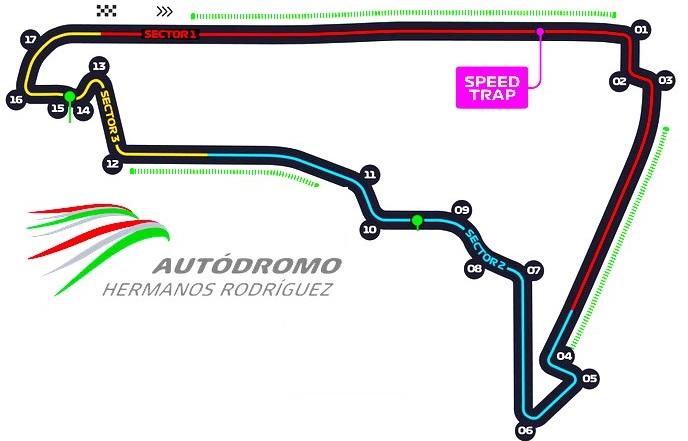
Designed as his thesis by student Óscar Fernández in 1953, the circuit has an elevation of 7,342 ft; the thin air causes difficulties for both the drivers and their cars. It also reduces the levels of aerodynamic drag that cars experience, meaning that higher downforce setups can be used with less impact on straight-line speed. The circuit has an extremely fast final corner (the Peraltada, turn 17) before a long start/finish straight, and thus reminded some of Monza,
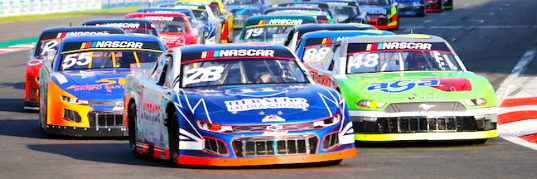
NASCAR Mexico Series
however, unlike Monza's Parabolica curve, the Peraltada curve is slightly banked, allowing even more speed through the corner. It was at this corner that the younger Rodríguez crashed, due to suspension failure. After the last F1 Mexican Grand Prix in 1992, a baseball stadium called the "Foro" was built on the inner part of this curve. When the
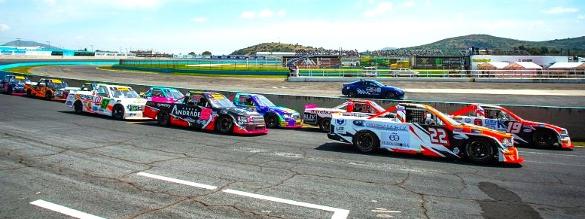
NASCAR Mexico Truck Series 2023
When the Champ Car series began using the track in 2002, the Peraltada curve was partially bypassed by a series of sharp turns entering and exiting the Foro; re-entering the Peraltada halfway through. After the Peraltada comes the long 1.2 km front straight. During the original turbo era in Formula One the faster cars were regularly clocking speeds of up to 205 mph on the straight. In 2005 NASCAR made their first visit to the track to race the Xfinity Series. Jorge Goeters would claim the pole, and
lead the first 24 laps. At that point Martin Truex bypassed Goeters to take the lead, and held it for eight laps. Adrian Fernanderz took the lead from Truex for just four laps, before Truex powered by to again gain the point. By this time the NASCAR regulars had started to find their way towards the front. Truex led the final 24 laps to get the win, followed by Kevin Harvick, Carl Edwards, Shane Hmiel and Boris Said. In 2005, there was a chicane on the main
straightaway to slow the cars down. They also introduced a curve between the short course and the Ese del Lago to bypass the latter, but avoiding the stadium detour. The NASCAR Xfinity Series started racing at Autódromo Hermanos Rodríguez in the 2005 season and ended in the 2008 season. In 2006, the NASCAR Xfinity stars were back in Mexico City for their second event. Road course ringer Boris Said won the pole, with Denny Hamlin starting along side. The race saw nine yellow flags,
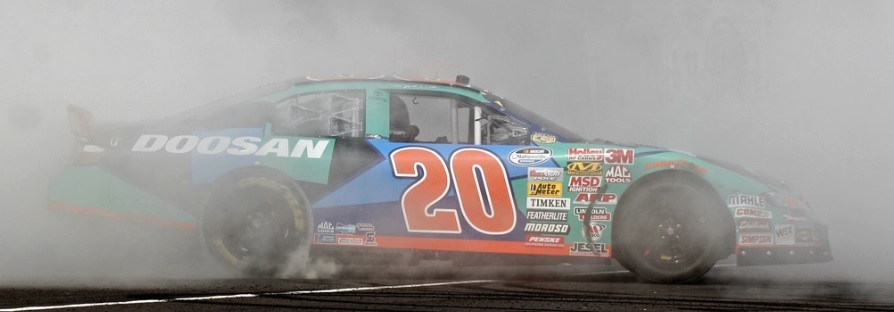
Kyle Busch Xfinity win 2008
chewing up 22 of the races 80 laps. Said led the first 26 laps, before Hamlin would find his way by to take the top spot for 12 laps. Kyle Busch would lead for five circuits, but the lead changed hand five times over the next nine laps as Marc Goossens, Said, Paul Menard, Carlos Contreras and Michael Jourdain all took turns at the front. Hamlin grabbed the lead with 28 laps to go and went on to claim the win. Said finished second, and Kevin Harvick third. For the 2007
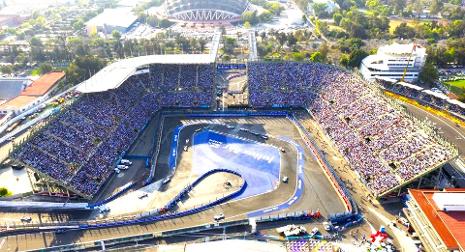
Recorte Rebaque (turn 6)
race, the chicane was removed to increase passing opportunities down the front straight and into turn 1. Scott Pruett won the pole and led the first three laps before F1 ace Juan Pable Montoya passed him for the lead. Montoya was strong leading at various stages of the race. Montoya eventually pulled out to a comfortable lead, but a series of late race yellows bunched up the field several times and it came down to a two lap shoot-out. Montoya was able to hold off Denny Hamlin to grab the win. Boris Said was third. 2008 was the final time the NASCAR drivers raced at the facility until they returned in 2025. That year the Cup stars would make their first trip to run at the historic track. In the 2008 Xfinity race, Colin Braun won the pole, and
Pruett started second. Braun led the first circuit, but Pruette worked his way by and led the next 15 laps. The race then saw a series of drivers each lead one lap before Scott Wimmer would claim the lead for 13 laps. Kyle Busch then had his first turn at the points as he led for 13 laps. Carl Edwards and Pruett each had the lead, before Busch got by with nine laps to go and went on to claim the win; on his way to a ten win season. The circuit also features an oval layout due to the inclusion of a flat turn that goes from the middle of the main straight to the beginning of
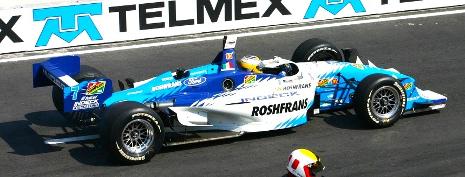
Indy Car Series
the backstretch of circuit. Unlike the road course, the oval is raced in counter-clockwise direction. The oval configuration of this Mexico City facility is arguably the most dangerous racetrack in Mexico, because of the limited visibility at the exit of turns 2 and 4. This is because the Foro Sol baseball stadium is located inside turns 1 and 2; and several trees are located inside turns 3 and 4. Before the 1986 Formula One race, the first turn (now turns 1-3) was named in honor of Moisés Solana, Mexico's third F1 driver. It is still called Ese Moisés Solana, often referred to as the "Solana Complex" in English. In September 2002, Mexico's fourth and, then most recent, F1 driver Héctor Rebaque's achievements both in F1 and CART were recognized by renaming turn 6 of the Autodromo as Recorte Rebaque instead of the previous name of Recorte de Gran Premio. In 2015, turn 17 was named in honor of Nigel Mansell, twice winner of the Mexican Grand Prix in 1987 and 1992, and the scene of his daring pass around the outside of Gerhard Berger in 1990. On September 20, 2016 Adrián Fernández's achievements have been recognized by the naming of turn 12 of the Autodromo in his honor. In June of 2025 the NASCAR Cup Series will have their first ever event at the track. More info when it occurs.
All Photos copyright and are property of their respective owners